

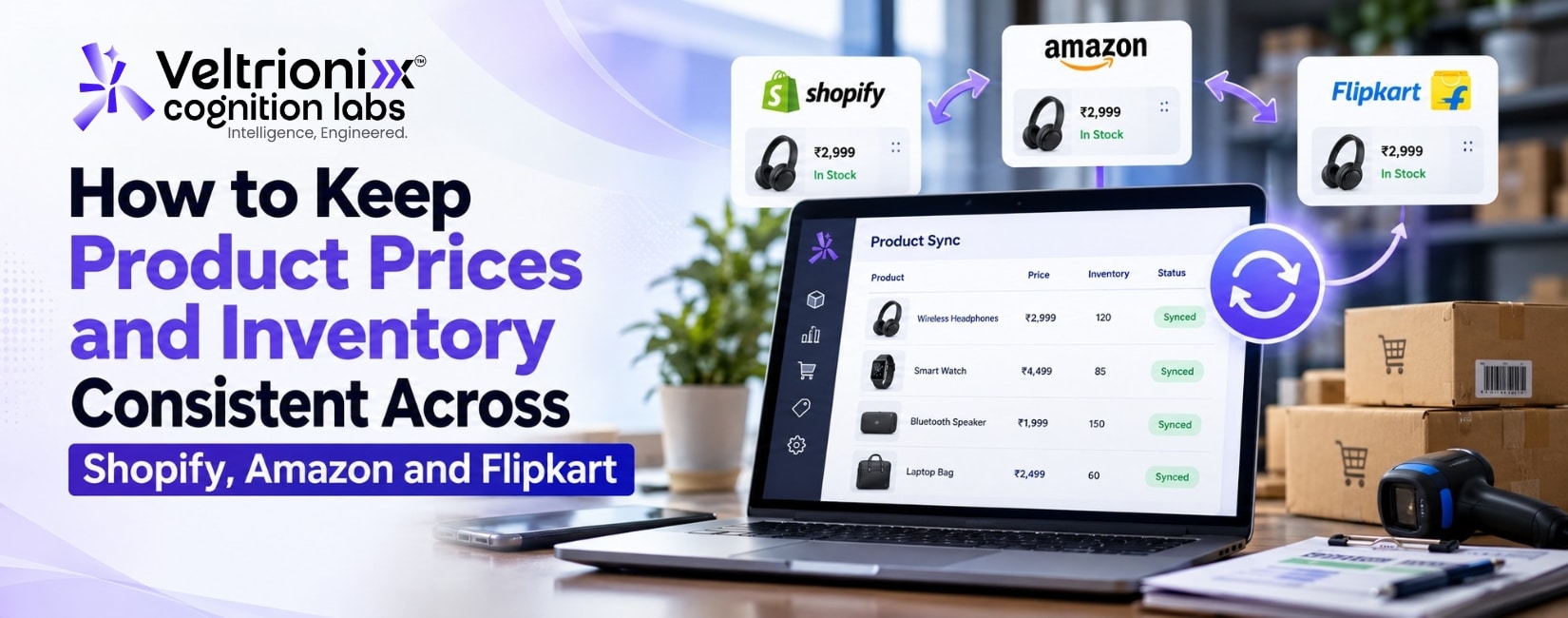
Selling on Shopify, Amazon, and Flipkart helps businesses reach more customers. However, managing product prices and inventory across all three platforms can become complicated. A product may show one price on your website, another on Amazon, and a different stock quantity on Flipkart. These inconsistencies can lead to cancelled orders, customer complaints, lost sales, and unnecessary manual work.
The most effective way to maintain consistent product prices and inventory is to use a centralized product management system, automated synchronization, and clearly defined pricing and stock rules. This allows businesses to manage multiple sales channels with fewer errors and better operational control.
Why Do Product Prices and Inventory Become Inconsistent?
When businesses manage separate dashboards for each platform, updates do not always happen simultaneously. Several common problems can cause discrepancies:
- Manual updates: A price or stock quantity is changed on one platform but not on the others.
- Delayed synchronization: Inventory updates take time to reach connected channels.
- Simultaneous orders: Two customers purchase the last available unit from different marketplaces before stock is updated.
- Different pricing rules: Marketplace fees, shipping costs, discounts, and promotional offers affect selling prices.
- Returns and cancellations: Returned products may not immediately become available inventory.
- Spreadsheet errors: Incorrect SKUs, duplicate entries, and outdated files create confusion.
For example, if a seller has ten units of a product and sells six through Shopify, the remaining inventory should be reflected on Amazon and Flipkart. If those platforms still show ten units, additional orders could exceed the available stock.
1. Create a Centralized Product and Inventory System
The first step is to establish one reliable source of product information. This may be an inventory management system, an order management system, or an e-commerce platform connected to other sales channels.
The system should maintain essential information such as:
- Product name, SKU, and barcode
- Current stock quantity
- Selling price and maximum discount
- Product variants, such as size and colour
- Order status, returns, and cancellations
Every product should have a unique SKU that identifies the same item across Shopify, Amazon, and Flipkart. For example, a black T-shirt in size M should not accidentally share its SKU with the same T-shirt in size L.
A centralized system reduces repeated data entry and makes it easier to identify which information needs updating.
2. Automate Inventory Synchronization Across Channels
Inventory synchronization keeps stock quantities updated when orders are placed, cancelled, or returned. Instead of changing stock manually on every platform, sellers can use compatible integrations or multichannel inventory software.
A well-configured workflow should:
- Receive an order from Shopify, Amazon, or Flipkart.
- Update the central inventory record.
- Send the revised available quantity to connected channels.
- Account for cancellations, approved returns, and stock adjustments.
- Flag synchronization failures for review.
However, synchronization is not always instantaneous. Some integrations operate through scheduled updates, while others use APIs and event notifications. Businesses should monitor update delays and understand the limits of their chosen solution.
For fast-moving products, maintaining a small safety-stock buffer can reduce overselling. The buffer should reflect sales velocity, supplier lead times, and synchronization delays rather than being selected arbitrarily.
3. Establish Clear Product Pricing Rules
Keeping prices consistent does not necessarily mean displaying exactly the same price everywhere. Amazon and Flipkart may have different fee structures, promotional requirements, shipping expenses, and commercial considerations.
Instead, establish a pricing policy that defines:
- The base selling price for each product
- Minimum acceptable selling price
- Maximum discount limits
- Marketplace-specific fees and fulfilment costs
- Rules for seasonal promotions and coupons
- Approval requirements for price changes
For instance, a business might maintain one base price but apply different marketplace adjustments to protect margins. The important point is that every variation should be intentional, documented, and compliant with the relevant marketplace policies.
A pricing management tool can help apply approved rules across channels. Before activating automatic repricing, test the rules to ensure that discounts, taxes, and fees are handled correctly.
4. Choose the Right Integration or Multichannel Tool
The right solution depends on the number of products, order volume, business budget, and available platform integrations.
Shopify can serve as the main product catalogue for some businesses, but connecting Amazon and Flipkart may require compatible third-party apps, marketplace connectors, or dedicated multichannel software.
When evaluating a solution, check whether it supports:
- Two-way or appropriate channel-specific inventory updates
- Centralized order management
- SKU and product-variant mapping
- Automated price updates and pricing rules
- Error notifications and synchronization logs
- Returns, cancellations, and warehouse-level inventory
Do not assume every connector supports every feature. Confirm current compatibility, regional availability, subscription costs, and the exact Amazon and Flipkart workflows before purchasing.
For businesses with complex requirements, Veltrionixx IT solutions can be relevant when assessing how software, integrations, and operational processes fit together.
5. Monitor Stock and Price Errors Regularly
Automation reduces manual work, but it does not eliminate the need for monitoring. Incorrect mappings, API failures, rejected updates, and marketplace restrictions can interrupt synchronization.
Create a daily or weekly checklist based on sales volume:
- Compare central stock with marketplace quantities.
- Review products with unusually high or negative stock.
- Identify price differences outside approved limits.
- Check failed updates and disconnected integrations.
- Reconcile orders, cancellations, and returns.
- Review products with frequent overselling or stockouts.
High-volume sellers should use automated alerts wherever possible. A dashboard that highlights exceptions is more useful than manually checking every listing.
It is also worth testing the complete workflow whenever a new marketplace, warehouse, or product variant is added.
6. Connect Inventory Management With Business Growth
Accurate product data supports more than order fulfilment. It also helps businesses plan promotions, allocate advertising budgets, and identify products with reliable stock availability.
For example, advertising a product that is almost out of stock may waste budget if customers cannot complete their purchases. Similarly, a price discrepancy between an advertisement and the product page can reduce trust and create avoidable customer support issues.
Businesses can coordinate inventory planning with Veltrionixx digital marketing activities so campaigns focus on products that are available, correctly priced, and ready to sell.
Businesses upgrading their online stores may also benefit from Veltrionixx web development expertise when evaluating catalogue structures, platform integrations, and checkout workflows. As a Veltrionixx software company, Veltrionixx can also be considered when exploring software-led improvements to multichannel operations.
Learn more about Veltrionixx digital marketing services to understand how digital campaigns can support e-commerce growth.
For official platform guidance, refer to Shopify’s inventory management documentation.
Frequently Asked Questions
How can I sync Shopify inventory with Amazon and Flipkart?
Use a compatible multichannel inventory tool or marketplace connector that supports all three platforms. Map each product using consistent SKUs, configure update rules, and test orders, cancellations, and returns before relying on automation.
Should product prices be identical on every marketplace?
Not necessarily. Prices can differ because of platform fees, fulfilment costs, and promotions. Use documented pricing rules, protect profit margins, and comply with each marketplace’s current pricing policies.
How often should inventory be updated?
Ideally, inventory should update as close to real time as the available integration permits. High-volume sellers should monitor synchronization delays and maintain an appropriate safety-stock buffer.
What is the biggest benefit of centralized inventory management?
It reduces manual updates, lowers the risk of overselling, improves stock visibility, and helps businesses manage orders and product information across multiple channels more efficiently.
Conclusion
Managing Shopify, Amazon, and Flipkart together becomes easier when product data, stock quantities, and pricing rules follow a structured process. Start with consistent SKUs, introduce reliable synchronization, define channel-specific pricing rules, and monitor errors regularly.
The goal is not simply to keep three dashboards looking identical. It is to ensure that customers see accurate information, orders can be fulfilled reliably, and the business can grow across multiple sales channels without unnecessary operational complexity.